Hemp Bioenergy Could Be Solar’s Perfect Partner in the Race to Carbon Neutrality
Hemp bioenergy paired with solar power offers a practical, scalable pathway to renewable energy independence that addresses two urgent needs: reducing fossil fuel dependence and transforming agricultural waste into clean power. Hemp produces four times more biomass per acre than most traditional crops, and when converted into biodiesel, ethanol, or biogas, it creates carbon-neutral fuel that complements solar installations during low-light periods and seasonal gaps. Those interested in wellness applications can shop cannabinoids from the same plant families that are now fueling biogas digesters and heating systems, proving that industrial hemp serves multiple markets simultaneously. This combination matters because neither technology works in isolation as effectively as together, creating a resilient energy ecosystem that communities, businesses, and even individual growers can implement starting today.
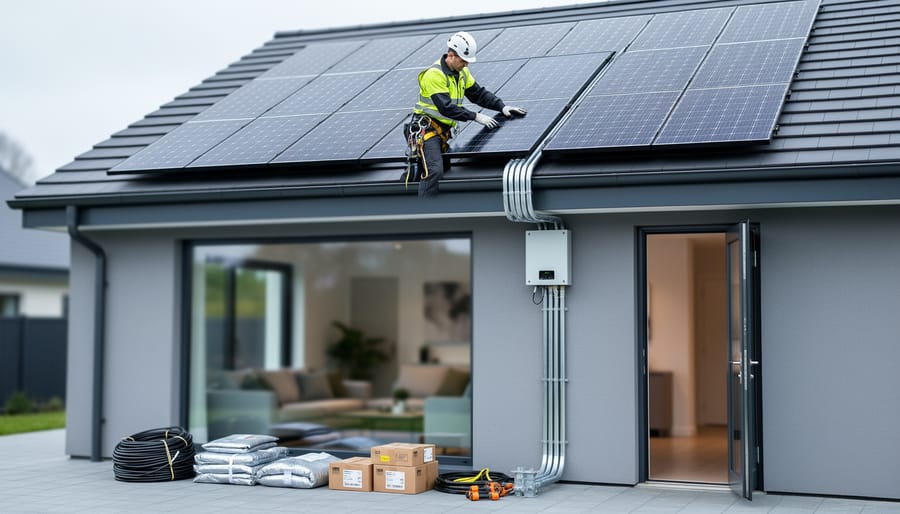
The intersection of hemp cultivation and solar sustainability has moved beyond theory. Farmers across North America and Europe are already integrating hemp into crop rotations while powering their operations with photovoltaic arrays, mimicking strategies similar to Germany’s renewables transition.
What makes this partnership particularly powerful is accessibility. Solar technology continues to drop in price while hemp cultivation requires minimal pesticides and thrives in diverse climates. Together, they create revenue streams that pay for each other: solar panels reduce processing costs for hemp biomass, while biofuel from hemp waste offsets energy storage limitations inherent to photovoltaic systems.
This article explores how hemp bioenergy and solar power work in tandem, the real-world applications already proving successful, and the specific steps you can take to participate in this growing movement. Whether you manage farmland, lead a business seeking energy independence, or simply want to understand emerging renewable solutions, the convergence of these technologies represents one of the most promising sustainable energy strategies available in 2026.
Understanding Hemp as a Bioenergy Crop
From Field to Fuel: Hemp’s Energy Potential
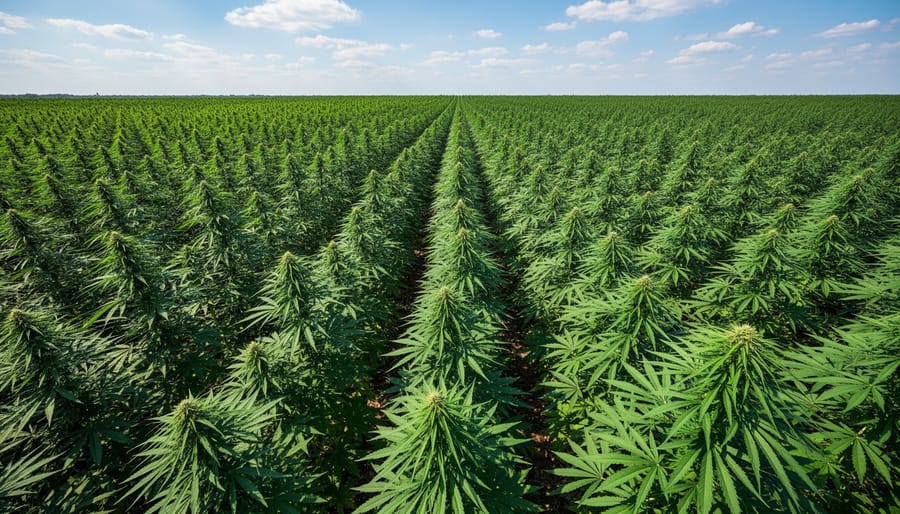
Hemp isn’t just a versatile crop for textiles and building materials. When you harvest it, nearly every part transforms into energy. The stalks, seeds, and leaves each become fuel through different processes, giving communities multiple pathways to power their homes and businesses.
Biodiesel from hemp seeds works much like other plant-based fuels. Pressing hemp seeds extracts oil that contains roughly 30-35% fat content. Processors then convert this oil through transesterification, essentially swapping out a molecule to create diesel that runs in standard engines. A single acre of hemp can yield 60-100 gallons of biodiesel, and it burns cleaner than petroleum diesel with fewer sulfur emissions.
Bioethanol comes from the fibrous stalks. Hemp contains cellulose and hemicellulose, complex sugars locked inside plant fibers. Breaking these down through fermentation releases ethanol, the same alcohol that powers flex-fuel vehicles. The process mirrors brewing, but instead of beer, you get fuel. Hemp’s rapid growth cycle means farmers can potentially harvest twice in one season in warmer climates, doubling the ethanol output per acre compared to slower-growing crops.
Biogas offers another route. Tossing hemp waste, leaves, trimmings, unusable stalks, into an anaerobic digester creates methane as bacteria break down the organic matter. This biogas heats buildings, generates electricity through turbines, or even fuels vehicles fitted with compressed natural gas systems. Small farms already use digesters for livestock waste. Adding hemp biomass increases their output without requiring new infrastructure.
Solid biomass fuel is the simplest option. Dried hemp stalks compress into pellets or briquettes that burn in furnaces and boilers, replacing coal or wood. They produce consistent heat with roughly half the ash content of wood, and the carbon released during burning is carbon the plant absorbed months earlier, making it nearly neutral.
Each pathway suits different scales and needs, from backyard pellet stoves to industrial power generation.
Where Solar and Hemp Bioenergy Complement Each Other
Filling the Solar Gap: Bioenergy for Energy Storage
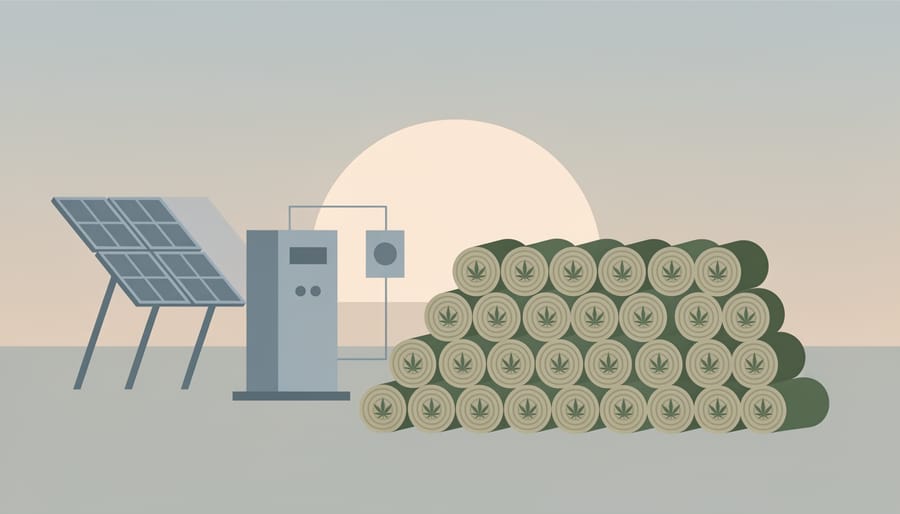
Solar power delivers clean energy when the sun shines, but nighttime and cloudy days create a reliability problem that batteries alone haven’t fully solved. Hemp bioenergy offers a complementary solution that works on a different timeline, storing solar energy indirectly through plant growth and converting it to on-demand fuel.
When hemp grows in fields, it captures solar energy through photosynthesis and locks it into biomass. That stored energy remains stable for months or years, unlike battery storage that depletes over time. Converting hemp into biodiesel, bioethanol, or biogas creates liquid and gaseous fuels that power generators during solar downtime, filling gaps that would otherwise require fossil fuels or expensive battery arrays.
This approach particularly benefits rural communities and microgrids where battery infrastructure costs run prohibitively high. A local hemp crop can feed a biogas digester that runs a generator for evening peak demand, while solar panels handle daytime loads. The system becomes self-sufficient without relying on distant power plants or diesel deliveries.
Hemp biofuels also provide longer-duration storage than current battery technology allows. While lithium-ion batteries typically discharge within hours, stored hemp biomass or processed biofuel can sit ready for weeks or months, creating true energy security for seasonal demand fluctuations or emergency backup. A farmer harvests hemp in autumn, processes it into fuel, and burns that fuel the following winter when solar production drops and heating needs spike.
The combination transforms solar from an intermittent resource into a foundation for reliable, round-the-clock renewable energy systems that communities can manage locally.
Dual-Purpose Land Use: Agrivoltaics with Hemp
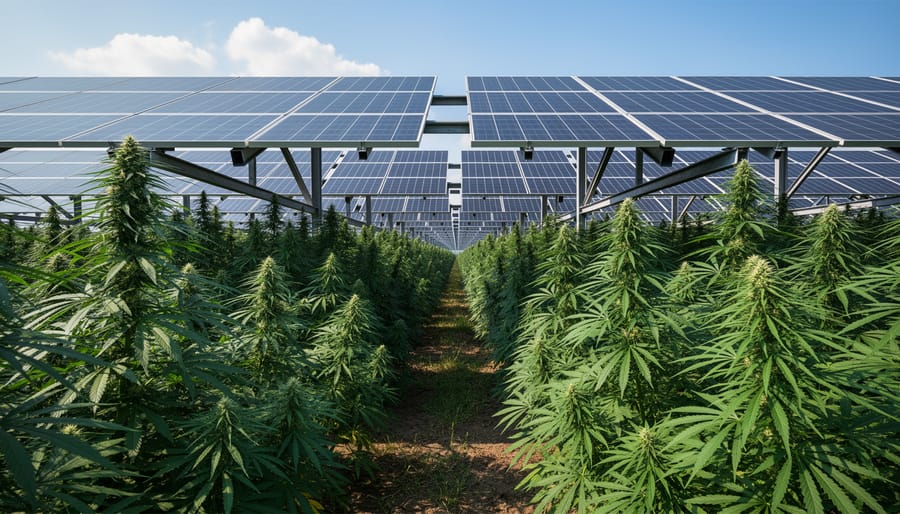
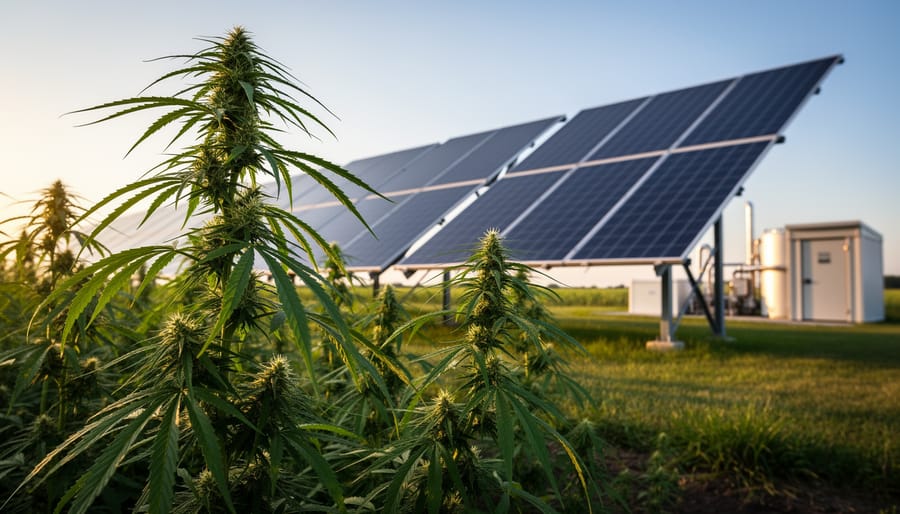
Agrivoltaics, the practice of combining agriculture with solar energy production on the same land, represents a breakthrough in sustainable land management, and hemp emerges as an ideal crop for this dual-use approach. By growing hemp beneath or between rows of solar panels, communities can generate clean electricity while simultaneously cultivating a valuable biomass crop, effectively doubling the renewable energy output from a single parcel of land.
Hemp thrives in partial shade conditions that typically exist under elevated solar arrays. Research from agricultural universities shows that hemp can maintain 70-85% of its typical yield even when grown in the diffused light beneath solar panels. This shade tolerance makes hemp exceptional compared to many conventional crops that require full sun exposure. The cooler microclimate created by the panels can actually benefit hemp during hot summer months, reducing water stress and extending the growing season in some regions.
The arrangement works both ways. Hemp’s dense foliage and robust root system help manage weeds beneath solar installations, reducing maintenance costs and the need for chemical herbicides. The plants also stabilize soil, prevent erosion, and improve ground conditions through their extensive root networks. When the hemp biomass is harvested, it creates fuel that can power backup generators or local energy systems during periods when solar generation drops.
Several pilot projects across Europe and North America are demonstrating this concept’s viability. Farms are installing solar arrays at heights that allow farm equipment to pass underneath, making hemp cultivation practical at commercial scale. The dual revenue stream, selling both solar electricity and hemp biomass, improves economic returns and makes renewable energy projects more financially attractive to landowners.
This integrated approach addresses a common criticism of solar farms: that they remove productive land from agricultural use. With hemp agrivoltaics, communities don’t have to choose between food security, energy independence, or land conservation. They achieve all three simultaneously, maximizing every acre’s contribution to a carbon-neutral future.
Real-World Applications: Communities Leading the Way
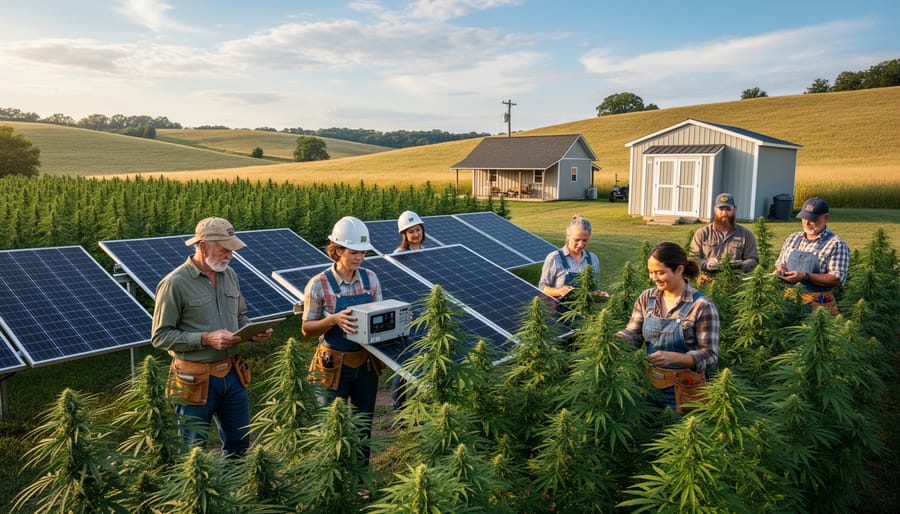
Small towns and rural communities across North America and Europe are proving that the hemp-solar partnership isn’t just theory. They’re building real systems that generate clean energy, create local jobs, and strengthen food security while working toward carbon neutrality.
In rural Kentucky, a farming cooperative launched a pilot project in 2024 that combines solar arrays with hemp cultivation on 200 acres of previously fallow land. The community installed solar panels across half the acreage while dedicating the remainder to high-density hemp crops. During growing season, the hemp absorbs carbon and produces biomass. Come winter, when solar generation drops, the cooperative processes hemp stalks into pellets that fuel a local biomass boiler, providing heat to a dozen community buildings including schools and a health clinic. The project cut the town’s heating costs by 40% in its first year while employing fifteen residents year-round in cultivation, processing, and system maintenance.
Across the Atlantic, a village collective in northern Italy took a different approach with agrivoltaics. They erected elevated solar panels high enough to allow hemp cultivation underneath. The panels provide partial shade that actually benefits the hemp during intense summer heat, reducing water needs by roughly 25%. The solar arrays generate electricity that powers the village and feeds excess into the regional grid, while the hemp produces biomass for local energy storage and fiber for construction materials. This dual-purpose land use doubled the productivity per acre compared to either energy source alone. Community members who once worried about losing agricultural identity to solar farms now see themselves as pioneers in integrated renewable systems.
In Ontario, a First Nations community partnered with a clean energy nonprofit to create a model that other Indigenous groups are now replicating. The initiative trains community members in both solar installation and hemp cultivation, ensuring that technical knowledge stays local rather than depending on outside contractors. The project transforms hemp waste from nearby CBD operations into compressed fuel bricks that supplement solar power during long northern winters. More than just energy generation, the program has become a source of pride and self-determination. Young people who might have left for cities are staying home to work in renewable energy jobs that honor traditional land stewardship values.
Vermont’s emerging initiative connects multiple small farms through a cooperative processing facility. Individual farms grow hemp and operate modest solar installations, then collectively process biomass into biodiesel that powers farm equipment and backup generators. This distributed approach means no single farm needs massive capital investment, making the hemp-solar model accessible to operations of varying sizes. The cooperative structure also shares knowledge and reduces risk, allowing farmers to experiment with new techniques while maintaining traditional crops.
These aren’t billion-dollar corporate ventures. They’re community-scale projects demonstrating that ordinary people can participate in building inclusive, resilient energy systems that work toward 2050 carbon goals while strengthening local economies today.
Environmental Benefits of the Hemp-Solar Partnership
The partnership between hemp bioenergy and solar power creates environmental benefits that exceed what either technology achieves alone. When hemp grows, it absorbs CO2 from the atmosphere at a rate up to four times faster than many trees, pulling roughly 1.63 tonnes of carbon per tonne of dry hemp produced. That captured carbon then gets locked into biofuel production, creating what researchers call “carbon-negative” energy when the hemp-based fuel replaces fossil alternatives. Pair this with solar installations that produce zero-emission electricity during daylight hours, and you have a renewable energy system that actively reverses atmospheric carbon accumulation rather than simply reducing new emissions.
The soil health improvements from hemp cultivation add another layer of benefit. Hemp’s deep taproots break up compacted soil, improve water infiltration by up to 25%, and suppress weeds naturally without herbicides. When hemp fields rotate with solar installations, whether through agrivoltaics or alternating land use, the soil continues to build organic matter and microbial diversity instead of lying dormant beneath panels. This living soil then sequesters additional carbon underground while supporting healthier ecosystems above ground.
Biodiversity benefits emerge when hemp fields replace monoculture crops or provide habitat restoration in former industrial zones. Hemp flowers attract over 16 species of pollinators during late-summer blooms when other food sources dwindle, creating crucial support for bee populations and other beneficial insects. In areas managing a coal regions transition hemp cultivation paired with solar farms offers an especially powerful restoration tool, turning degraded land into productive carbon sinks while providing renewable energy and jobs.
The cumulative effect positions this partnership as one of the fastest pathways to meaningful carbon neutrality. Independent analyses suggest that scaling hemp bioenergy alongside solar expansion could offset an additional 30-40% of transportation sector emissions by 2050 compared to solar-only scenarios, while simultaneously rebuilding soil carbon stocks that industrial agriculture has depleted over decades. This is not incremental progress, it is system-level transformation that addresses energy, agriculture, and ecosystem health simultaneously.
Overcoming Barriers: Policy, Perception, and Practical Challenges
Despite the clear environmental promise, scaling hemp bioenergy alongside solar faces three interconnected hurdles: outdated regulations, public confusion, and significant infrastructure gaps.
Regulatory confusion remains the most immediate barrier. In many regions, industrial hemp cultivation still operates under restrictive frameworks designed for psychoactive cannabis, requiring extensive permits and background checks even though hemp contains negligible THC. Farmers interested in growing energy crops face lengthy approval processes that deter participation. Meanwhile, existing agricultural subsidy programs favor traditional crops over hemp, creating financial disincentives. Policymakers championing a solar Green Deal must extend that same progressive thinking to hemp cultivation, streamlining permits and aligning incentives with climate goals rather than outdated drug policy concerns.
Public perception compounds the problem. Many people still conflate industrial hemp with marijuana, assuming hemp farms enable drug production. This misconception creates community resistance to local hemp projects, even when those projects would generate clean energy and economic opportunities. Educational campaigns explaining the botanical and legal distinctions between hemp and cannabis remain critically underfunded. When communities understand that energy hemp is simply a fast-growing plant producing biomass fuel, no different in function from switchgrass or miscanthus, opposition typically dissolves.
Infrastructure presents the third major challenge. Unlike solar panels that connect directly to existing electrical grids, hemp bioenergy requires processing facilities to convert raw biomass into usable fuel. Few regions have biodigesters, pyrolysis units, or biodiesel refineries capable of handling hemp at scale. Building this infrastructure demands substantial upfront investment, and financing remains difficult when lenders view hemp ventures as higher-risk due to its regulatory uncertainty. The irony is stark: we readily finance solar farms under policy frameworks supporting renewables, not fossil fuels, yet hesitate to fund the complementary bioenergy systems that would make those solar installations more reliable.
Financing challenges extend beyond infrastructure. Crop insurance programs often exclude hemp because it’s considered “alternative,” leaving farmers vulnerable to weather losses without the safety net available for corn or soybeans. Grant programs focused on renewable energy frequently overlook agricultural solutions, treating bioenergy as separate from mainstream clean energy despite its carbon-sequestering advantages.
Addressing these barriers requires coordinated action: regulators simplifying hemp permits, educators dispelling myths, infrastructure investors recognizing hemp’s role in energy resilience, and financial institutions developing products tailored to integrated agricultural-energy ventures. The technical solutions exist; political will and public understanding lag behind.
How You Can Support This Dual-Energy Future
You don’t need to wait for governments or corporations to make this happen. Here’s how you can actively support the integration of hemp bioenergy and solar power, no matter your background or resources.
For Individuals and Households
Start by learning and sharing. When you understand how hemp and solar complement each other, you become an advocate in everyday conversations. Talk to your neighbors, local officials, and community groups about the potential. If you’re considering solar panels, ask installers about agrivoltaic opportunities or future biofuel backup systems.
Support hemp farmers in your region by purchasing hemp-based products, which strengthens the economic case for expanding hemp cultivation. Contact your elected representatives to express support for policies that ease hemp farming restrictions and incentivize renewable energy partnerships. Your voice matters more than you think, policymakers often respond to constituent interest.
Consider community solar projects that explore dual-purpose land use. Many regions allow residents to invest in or subscribe to shared solar installations, and some are beginning to incorporate agricultural elements.
For Educators and Community Leaders
You shape how the next generation thinks about energy solutions. Integrate hemp bioenergy concepts into existing environmental curricula alongside solar education. When you teach students energy principles through hands-on projects, growing fast-cycling plants, tracking solar production, or calculating carbon footprints, you’re building the foundation for tomorrow’s innovators.
Organize community forums or workshops that bring together farmers, solar advocates, and local businesses to discuss practical implementation. Facilitate connections between groups that might not otherwise collaborate. These conversations often spark pilot projects that become regional models.
Partner with agricultural extension offices or renewable energy organizations to create demonstration sites where community members can see hemp-solar systems in action. Seeing is believing, and tangible examples overcome skepticism faster than any presentation.
For Business Leaders and Entrepreneurs
Explore agrivoltaic investments that combine solar development with hemp cultivation. The dual revenue streams, selling both electricity and biomass, can improve project economics while demonstrating environmental leadership. Talk to solar developers about incorporating agricultural components into utility-scale projects.
If you operate in the energy sector, advocate for interconnection standards that accommodate biofuel backup systems. Push for grid infrastructure improvements that enable seamless switching between solar and bioenergy sources.
Manufacturing and processing businesses can invest in equipment that converts hemp biomass into usable fuels, creating local jobs while building the supply chain this transition requires.
For Policymakers
Champion legislation that removes unnecessary barriers to hemp cultivation while maintaining appropriate oversight. Create financial incentives, grants, tax credits, low-interest loans, for integrated hemp-solar projects, particularly in rural and underserved communities.
Fund research partnerships between agricultural universities and renewable energy labs to generate the data needed for informed decision-making. Support workforce development programs that train people in both solar installation and biomass energy production.
Mandate renewable energy portfolios that recognize bioenergy’s role in grid stability, not just its carbon profile. Update building codes and agricultural zoning to accommodate agrivoltaic systems without bureaucratic roadblocks.
The pathway to carbon neutrality requires all of us. Whatever your role, you have power to accelerate this dual-energy future.
The path to carbon neutrality by 2050 doesn’t require choosing between energy solutions. It demands we embrace them together. Hemp bioenergy and solar power aren’t competitors, they’re allies in a transformation that reaches beyond technology into how we think about energy itself.
Solar captures the sun’s daily gift. Hemp stores carbon while it grows, then releases reliable energy when clouds gather or night falls. Together, they create something neither can achieve alone: a renewable system that adapts to real-world needs while accelerating our departure from fossil fuels.
We’ve seen communities harness this partnership. Farmers growing hemp beneath solar arrays, producing both electricity and biomass from the same land. Towns powering themselves with sunshine by day and hemp-derived fuel when darkness comes. These aren’t distant possibilities. They’re happening now, proving that practical solutions exist when we stop treating sustainability as sacrifice.
Your role in this future matters. Whether you’re advocating for clearer hemp policies, investing in dual-energy infrastructure, educating your community about these complementary technologies, or simply supporting businesses that embrace both, you’re part of the momentum. Every voice strengthens the case for inclusive, diverse energy systems that work for everyone.
The race to carbon neutrality isn’t won by any single solution. It’s won by all of us, choosing partnerships over purity, progress over perfection, and possibility over doubt.